#Farm Machinery & Equipment
The 6 Mistakes to Avoid When Installing a Flexible Tank
Austria Agriculture use
Check how to avoid common mistakes before installing a flexible tank on your property to collect rainwater.
Installing a Flexible Tank: 6 Mistakes You Must Absolutely Avoid
Repeated droughts, watering restrictions, rising water bills: capturing and storing rainwater with a flexible tank is undoubtedly one of the most effective solutions for achieving sustainable water savings. Especially since installation is particularly easy, provided you avoid a few pitfalls. Here are the six mistakes not to make in order to choose your tank wisely and position it correctly.
1— Undersizing (or oversizing) the capacity of the flexible tank
This is the most strategic point: a tank that’s too small will fill up after the first rainfall and won’t cover your needs during dry spells. On the other hand, an oversized tank is more expensive, takes up space, and will rarely (if ever) be completely filled.
Two parameters will guide your choice:
Your water storage needs: estimate them as accurately as possible, taking into account all the uses you plan for:
Watering plants and flowers
Irrigating gardens and vegetable plots
Washing (car, floors, etc.)
Household use (washing machine, sanitary equipment, etc.)
Filling ponds or basins
Your potential rainwater yield: for this you’ll need three data points:
The catchment area (S) of the roof(s). Generally, this corresponds to the ground footprint of the building.
The average rainfall (P) in your region, in liters per m² per year.
The runoff coefficient (D), which reflects losses. The steeper the roof, the better the collection. For example: 0.6 for a flat roof vs. 0.9 for a well-sloped tiled roof. The calculation is simple: S × P × D.
At SERENA, our standard flexible tank volumes range from a few hundred liters to several dozen m³: choose according to your actual needs.
2 — Installing the tank on unprepared ground
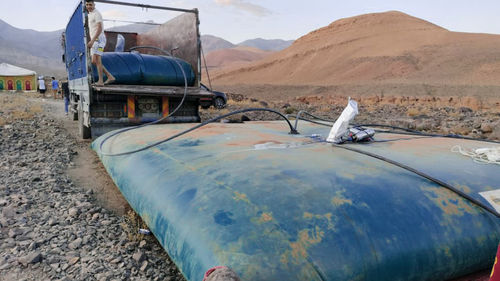
Bumps, stones, roots, or debris can puncture the liner, create wear points, and compromise stability. Water then stagnates in pockets, connections are strained, and leaks occur.
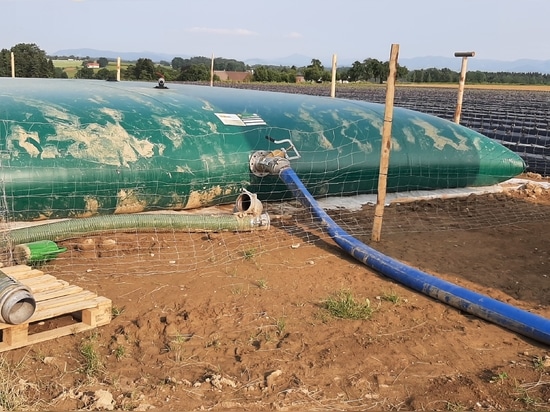
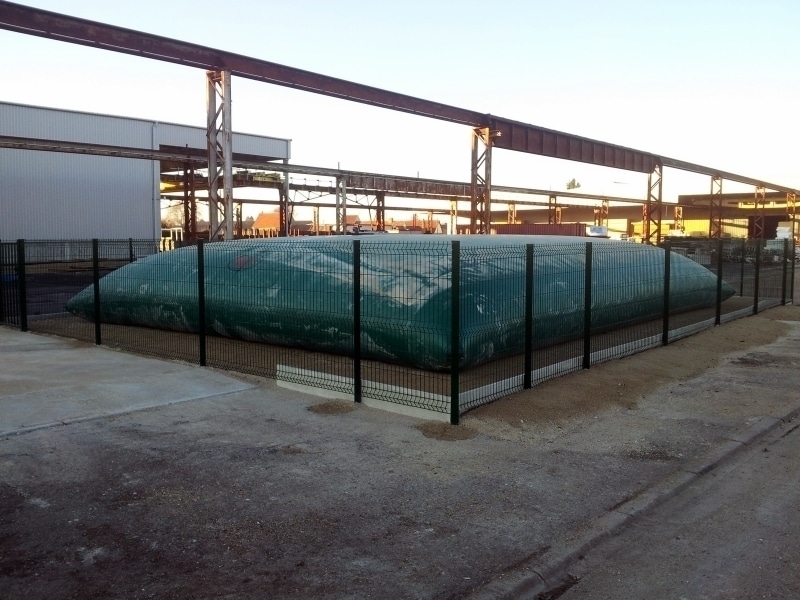
The solution is to prepare a flat, stable, and perfectly clean surface (smooth concrete slab, compacted sand bed, etc.). We recommend laying a geotextile (300 g/m² or higher; we also offer 650 g/m² PVC ground mats) to prevent friction and protect against roughness. Our installation manual provides all the necessary details.
3 — Neglecting rainwater filtration
From roof to gutter, rainwater mixes with leaves, dust, and sand that accumulate in downpipes and in the tank. The result: blockages, impure water, rapid pump wear, unpleasant odors, and contaminated storage. A poorly managed overflow can even cause incidents such as flooding, backflow to the roof, or tank damage.
It is therefore essential to install simple and accessible pre-filtration upstream (such as gutter guards, downpipe filters, or fine mesh baskets). At the tank inlet, add a filter and a floating strainer on the suction side to capture the cleanest water between the bottom and surface.
4 — Choosing the wrong pump and pipes
An undersized pump will deliver insufficient flow, limiting irrigation and making the system ineffective. An oversized pump consumes too much energy, risks running dry, and wears out quickly. Likewise, pipes that are too narrow cause pressure losses, strain the pump, and shorten its lifespan.
Choosing the right pump is straightforward: once your intended uses are defined (drip irrigation, oscillating sprinkler, washing, etc.), calculate the total head (HMT = elevation + pressure losses + desired pressure). This tells you which pump to select, whether submersible or surface.
For piping, choose appropriate diameters (e.g., PE32/PE40 for long distances), use high-quality fittings (brass or stainless steel, with new seals), and install a pressure switch or booster if supplying multiple outlets.
5 — Ignoring legal regulations on rainwater harvesting
While it is perfectly legal to collect rainwater for personal use, there are legal obligations in certain cases. Ignoring them may result in fines.
A flexible tank used only outdoors (watering, washing, filling ponds, etc.) does not require any formalities.
However, if you use rainwater inside your home, there are restrictions: it can only be used for non-drinking purposes (e.g., toilets, washing machine). In this case, a declaration at the town hall is mandatory, under penalty of sanctions. Municipal officers must be able to check that your system complies with regulations.
For obvious sanitary reasons, there must always be a physical separation between the rainwater network and the potable water network (using a backflow preventer). Label all draw-off points with “Non-potable water.”
6 — Forgetting maintenance and upkeep
Leaves and debris always accumulate. Without regular checks, blockages form, flow decreases, and the pump deteriorates. In addition, unprotected installations can suffer frost damage in winter, particularly valves and fittings.
SERENA flexible tanks are easy to maintain. Still, vigilance is required: carry out a visual inspection every 2–3 months, checking connections, valves, filters, and strainers. Purge the tank if water remains unused for long periods.
Our tanks resist both frost and summer heat (as long as the liner does not exceed 70 °C) and do not require draining. However, the valve at the tank outlet must be protected from freezing—otherwise it may crack and leak during thawing. Insulate the valve with protective sheathing, and if temperatures fall below –10 °C, drain the water circuit at the valve.
Conclusion
Installing a flexible tank is actually very simple… if you anticipate the right parameters: capacity, platform, filtration, overflow, fittings, and pump. By avoiding these six common mistakes, you ensure a safe, durable, and efficient rainwater collection system, maximize water savings, and gain autonomy in the face of droughts.
Need advice on choosing the right capacity, calculating rainwater yield, or selecting filters, pumps, and accessories? The SERENA team is here to support you every step of the way—from sizing to commissioning.