#Research & Development
Give Every Seedling a Fighting Chance: Biodegradable Water-Retention Agents for Tree Transplanting
Mixing Hydrogel into the Root Zone at Transplant Time Can Raise Sapling Survival Rates Dramatically — Then Vanish Without a Trace
Introduction
Anyone who has run a tree planting project knows the painful arithmetic of the first year. You source quality saplings, schedule the crews, dig the holes — and then watch a percentage of your trees simply fail to take. In afforestation and reforestation projects, first-year seedling mortality of 15–30% is common in dry regions; in severe cases it exceeds half. Every lost seedling means replanting costs, a lost growing season, and an uneven stand that compromises the project for years.
The culprit, more often than not, is water. A transplanted sapling is a plant in crisis: its root system has been cut back or confined, its ability to seek out moisture is severely limited, and it must re-establish root-soil contact in soil it has never touched. The gap between planting day and the first rains — or the next irrigation round — is where most seedlings die.
A fully biodegradable water-retention agent, mixed into the root zone at the very moment of transplanting, is designed to close exactly this gap. It captures water at planting, holds it in the reach of the young root system, releases it slowly during the critical establishment weeks — and then biodegrades completely, leaving nothing in the soil but a stronger, self-sufficient young tree.
Why Transplanting Is the Most Vulnerable Moment in a Tree's Life
Understanding the mechanism makes the solution obvious. When a sapling is lifted from the nursery, it loses a large share of its fine absorptive roots — the ones responsible for nearly all water uptake. What remains must supply the entire above-ground stem and foliage from a drastically reduced intake capacity.
Three problems compound at once:
- Root-soil contact is poor. Air pockets around the root ball dry out the remaining fine roots rapidly.
- Water demand is immediate. The sapling continues to transpire through leaves and stem even as its intake capacity collapses.
- The clock is unforgiving. If functional roots do not regenerate and connect to reliable moisture within days to weeks, the seedling desiccates beyond recovery.
Traditional countermeasures — heavy watering immediately after planting, shading, root pruning of foliage — help, but they are labor-intensive, often impractical on large or remote planting sites, and they address symptoms rather than the core problem: moisture is not staying where the new roots can reach it.
How a Biodegradable Hydrogel Changes the Establishment Equation
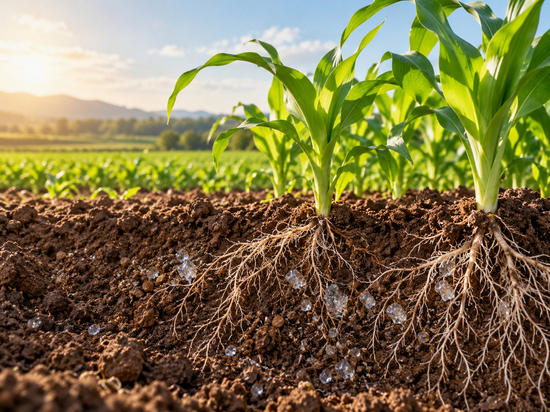
Water-retention agents are superabsorbent polymers that absorb and hold hundreds of times their weight in water, forming a gel reservoir within the soil. When incorporated into the planting hole or blended with the backfill around the root ball at transplanting, they perform three functions precisely when the seedling needs them:
1. A water battery charged at planting. The gel is hydrated during the initial watering (or by mixing pre-hydrated gel with backfill). This water is then held in the root zone rather than draining away beyond the reach of the young roots.
2. Slow release matched to root regeneration. As surrounding soil dries, the gel releases moisture back to the roots — a steady supply during the weeks when new root growth is most active. The seedling effectively grows its root system toward and around the gel reservoirs.
3. Improved root-soil contact. The swelling gel fills air pockets around the root ball, keeping fine roots in intimate contact with moist soil instead of dry air.
The agronomic result has been documented across planting programs: significantly higher first-season survival, faster early height and diameter growth, and more uniform stands — because the trees that would have become stragglers instead establish alongside their neighbors.
The Decisive Advantage: Complete Biodegradation
Here is where modern formulations separate themselves from the synthetic superabsorbents of the past. Tree planting is a long-horizon activity — the soil you improve today is the soil that must support that tree for decades. Persistence is not neutral; it is a defect.
Fully biodegradable water-retention agents are built on natural polysaccharide platforms (starch, cellulose, or chitosan-based chemistries). They perform their water-holding function through the establishment period, and then soil microorganisms consume them completely — typically achieving ≥90% biodegradation within one growing season under standard test regimes such as OECD 301. The end products are simply water, carbon dioxide, and microbial biomass.
What this means for a planting project:
- No polymer accumulation in the root zone. Apply at planting; nothing remains to interact with root development in later years.
- Zero microplastics in forest soils. Increasingly a requirement for public lands, certified forestry programs, and environment-conscious sponsors.
- Safe for the ecosystem being restored. The whole point of planting trees is to build soil and ecosystem health — the amendment should not quietly work against it.
- Fit for organic and regenerative programs. Fully compatible with soil-health-oriented planting standards (verify specifics with your certifier).
The logic is compelling: a helper that does its job during the tree's most fragile weeks, then gets out of the way entirely.
Application: Simple, Flexible, Field-Tested
The product integrates into existing planting workflows with minimal training:
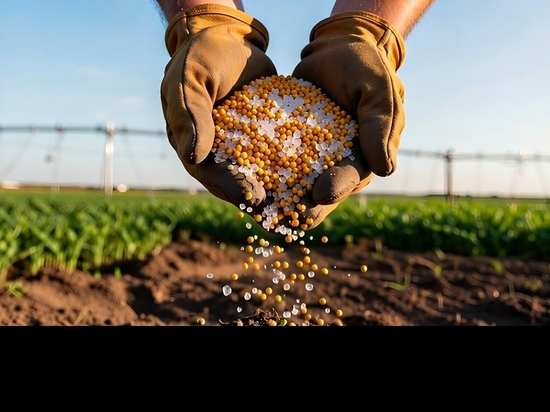
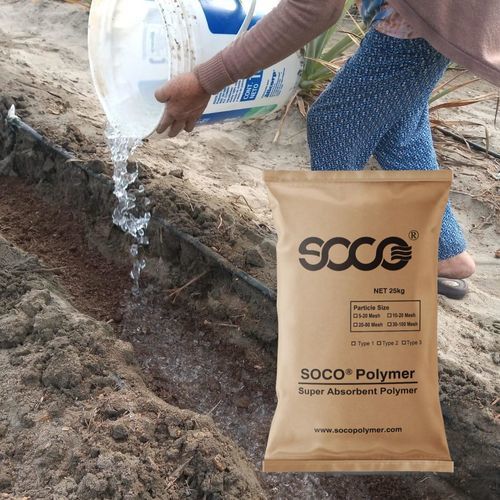
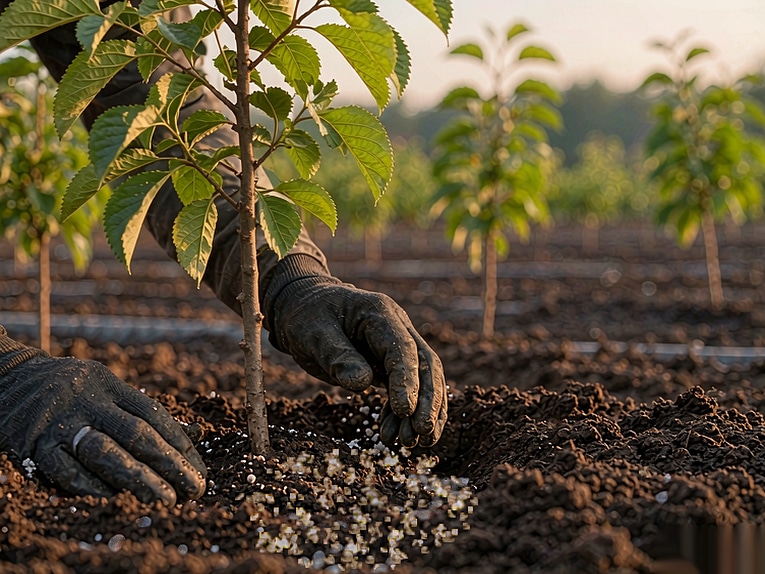
- Dry application (most common): Apply the dry granules into the planting hole or mix them with backfill soil around the root ball at a typical rate of 5–20 grams per seedling (adjusting for species, site aridity, and hole volume), then water in. On large sites, the agent can be pre-mixed into backfill piles for crew consistency.
- Pre-hydrated gel dip or slurry: For high-value or drought-site plantings, hydrate the polymer into a gel and dip the root ball or coat the roots before planting — maximizing immediate root contact.
- Nursery integration: The agent can also be incorporated at the nursery stage into seedling containers or beds, so the root system develops within the moisture-buffered medium before it ever reaches the field — a genuine head start on establishment.
- Combined with standard practice: It works alongside watering, mulching, and shading; it does not replace them, it multiplies their effect by keeping applied water in place far longer.
Practical note: the agent manages moisture, it does not create it. An initial watering at planting (or well-timed rainfall) is needed to charge the reservoir. On sites with absolutely no available moisture at planting, irrigation must still be planned.
The Economics: Survival Rate Is the Whole Business Case
For any planting program, the calculation is refreshingly direct. Replanting a failed seedling costs the price of a new sapling plus a second site visit by the crew — commonly 2–3 times the original planting cost per tree, plus a lost growing season and a staggered stand.
If mixing a few grams of biodegradable hydrogel into each planting hole lifts survival by even 10–20 percentage points — well within what field programs report on moisture-limited sites — the input pays for itself several times over in avoided replanting alone, before counting the value of faster early growth and a uniform stand.
For commercial orchard establishment, agroforestry, roadside and urban planting, and large-scale afforestation alike, the decision framework is identical: the cheapest tree is the one that survives the first time it is planted.
Conclusion: Establishment Is Everything
A tree that establishes strongly in its first season carries that advantage for its entire life. A tree that struggles early may never catch up — or may not survive at all.
Fully biodegradable water-retention agents turn the most fragile phase of a tree's life into its most protected one: water held at the young roots, released as new roots grow, delivered by a material that then returns completely to the soil it helped bring to life.
Plant once. Survive once. Leave no trace. For any tree planting program managing its survival rates this season, that is the standard to insist on.