#Research & Development
Soil Hydrogels for Slope Greening: Improving Vegetation Establishment and Erosion Control
How Potassium Polyacrylate Super Absorbent Polymers Support Hydroseeding, Reduce Runoff, and Cut Maintenance Costs on Embankments and Cut Slopes
Soil Hydrogels for Slope Greening: Improving Vegetation Establishment and Erosion Control
Exposed slopes along highways, railways, mining sites, riverbanks, and urban infrastructure are among the most difficult environments for vegetation establishment. Steep gradients accelerate surface runoff, thin or degraded soils drain and dry out rapidly, and newly sprayed seeds are frequently washed away before germination even begins. As extreme rainfall events become more frequent, uncontrolled slope erosion now threatens the structural integrity of embankments and drives up long-term maintenance costs.
Integrating agricultural-grade potassium polyacrylate soil hydrogels into slope greening programs gives contractors and ecological restoration teams a practical tool for keeping moisture in the root zone long enough for vegetation to take hold — turning vulnerable bare slopes into self-sustaining, erosion-resistant landscapes.
Why Slope Vegetation Fails: The Core Challenges of Slope Greening
Slope greening and ecological restoration projects face a set of interlocking obstacles that flat-field agriculture rarely encounters:
Rapid Surface Runoff & Low Infiltration: On gradients steeper than 1:2, a large share of rainfall runs off before it can infiltrate the soil. Seeds and fertilizer are carried downslope, and the root zone stays dry even after significant rain.
Drought Stress Between Rainfall Events: South-facing cut slopes and sandy embankment fills lose residual moisture quickly. Seedlings that do germinate often die within weeks of the last rainfall.
Seed and Mulch Washout: In hydroseeding operations, immature mulch layers and ungerminated seed are highly vulnerable to the first heavy storm after spraying, forcing expensive re-application.
Nutrient Leaching on Gradients: Water-soluble fertilizers applied to slopes migrate downslope with runoff instead of remaining available to establishing plants.
Rill and Gully Erosion: Concentrated runoff carves erosion channels that undermine engineering protections, sediment drainage systems, and surrounding water quality.
How Soil Hydrogels Work on Slopes
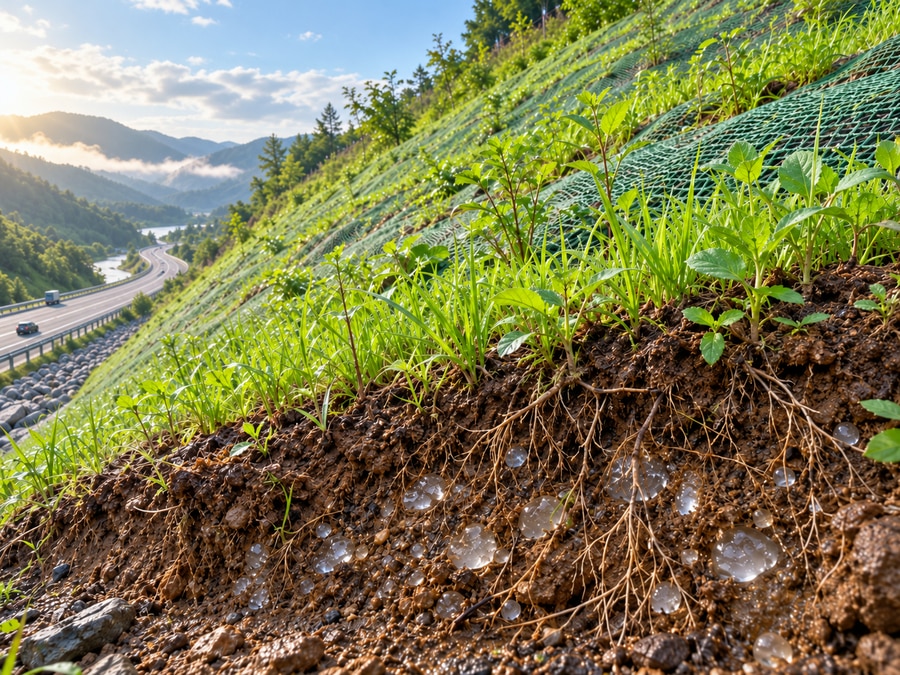
Potassium polyacrylate is a high-capacity super absorbent polymer (SAP) engineered for vegetation applications. Its three-dimensional cross-linked network absorbs hundreds of times its dry weight in water, forming a soft transparent hydrogel that acts as a network of micro water reservoirs distributed through the slope's surface soil layer.
When the surrounding soil dries, the polymer releases over 80% of its stored water back to plant roots along a natural water-potential gradient, buffering seedlings through dry spells. Between rainfall events, this sustained moisture availability dramatically improves both germination rates and early seedling survival — the two most failure-prone stages of any slope revegetation project.
Swollen hydrogel particles also improve soil aggregation and reduce surface crusting, which increases infiltration during rainfall and slows the runoff that drives erosion. Unlike sodium-based industrial absorbents, potassium-based formulations degrade naturally without causing soil salinization, making them suitable for sensitive ecological restoration and land reclamation sites.
Application Methods for Slope Greening Projects
Integration with Hydroseeding:
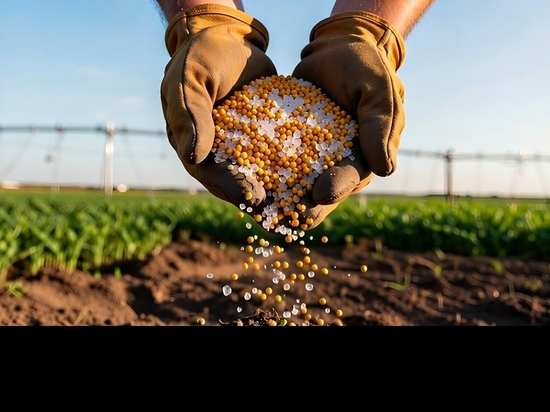
For large-scale embankment greening and roadside revegetation, dry potassium polyacrylate granules are mixed directly into the hydroseeding slurry — together with seed, mulch fiber, fertilizer, and tackifier — and sprayed uniformly over the slope surface. Typical dosage rates range from 3–10 g per square meter, adjusted to slope gradient, rainfall pattern, and soil type. The polymer locks moisture around the seed zone immediately after application.
Dry Broadcast for Accessible Slopes:
On gentler slopes accessible to machinery, dry polymer granules are broadcast together with grass seed and fertilizer, then lightly tilled into the top 10–15 cm of soil and irrigated to activate absorption.
Gel Slurry for Shrub and Sapling Planting:
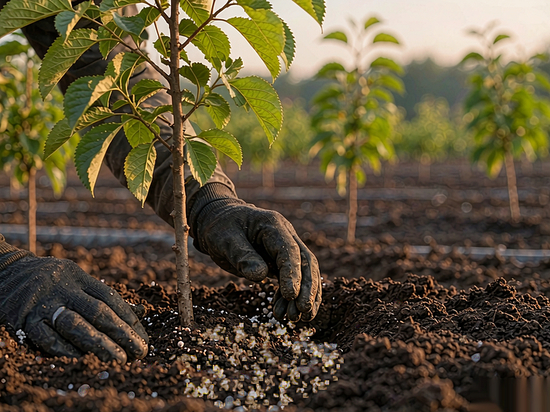
For woody species planted into steep or rocky sections, pre-hydrated hydrogel slurry is placed directly into planting holes around the root ball, securing moisture through the critical establishment period and significantly raising transplant survival rates.
Key Benefits for Slope Stabilization and Ecological Restoration
Stronger Erosion Control: Higher soil moisture and improved aggregation reduce crust formation and surface runoff, limiting rill development during the vulnerable first seasons.
Higher Germination and Survival Rates: A continuously hydrated seed zone means hydroseeding investments survive dry spells instead of requiring costly re-spraying.
Reduced Irrigation and Maintenance Costs: Slopes are rarely irrigable; soil hydrogels extend the effective window of natural rainfall, cutting watering trips and replanting labor.
Better Nutrient Use Efficiency: Dissolved fertilizers are held in the root zone matrix rather than leaching downslope, protecting adjacent waterways from nutrient runoff.
Compatibility with Engineering Measures: Soil hydrogels complement geotextiles, erosion control blankets, and grid beam structures rather than replacing them — adding biological long-term stability to structural protections.
Typical applications include highway and railway embankment greening, mining and quarry reclamation, riverbank and canal slope protection, landfill capping, and dust-prone industrial soil surfaces.
Frequently Asked Questions (FAQs)
Q1: What dosage of soil hydrogel should be used in hydroseeding?
Most hydroseeding specifications call for 3–10 g of potassium polyacrylate per square meter, depending on slope gradient, local rainfall, and soil texture. Steeper, drier, sandier sites sit at the higher end of the range.
Q2: Will the hydrogel wash out during heavy rain?
Once hydrated and incorporated into the surface soil layer — and used together with mulch and a tackifier — the swollen gel particles are anchored in the soil matrix and are not washed away by normal rainfall.
Q3: How long does the polymer remain effective in slope soils?
Depending on soil conditions and microbial activity, potassium polyacrylate typically continues absorbing and releasing water for several seasons — usually long enough for vegetation cover to become self-sustaining.
Q4: Is it safe for ecological restoration sites?
Yes. Potassium-based SAPs are non-toxic, degrade into potassium-rich residues beneficial to plants, and do not cause the soil salinization associated with sodium-based polymers.
Partner with SOCO® for Slope Greening Polymer Solutions
Looking to improve vegetation establishment and erosion control performance on your slope greening, hydroseeding, or land reclamation projects? SOCO New Material supplies premium potassium polyacrylate soil hydrogels with customized particle sizing, technical dosage support, and bulk volumes for contractors and distributors worldwide.