#Crops
Professional Sticky Rolls for Greenhouses: Why Do Some Traps Lose Effectiveness Too Soon?
Installing chromatic sticky traps in a greenhouse is relatively simple.
The real test begins after several weeks of use, when heat, humidity, dust, crop treatments and daily handling start affecting both the adhesive and the supporting material.
For a professional grower, a trap that loses its adhesive capacity too early creates more than a product cost. It also means replacement work, additional labour and potentially less effective trapping during a critical period of the crop cycle.
For this reason, choosing a sticky roll or chromatic trap should involve more than colour and purchase price.
What determines the quality of a greenhouse sticky roll?
The adhesive is one of the first factors to consider. It must maintain enough trapping capacity during the expected period of use despite changing greenhouse conditions.
The supporting material is equally important. A roll that stretches, deforms or tears during installation becomes harder to handle and may reduce the effective trapping surface.
These differences become much more important in professional greenhouses where hundreds or thousands of metres of material may be installed. A small quality difference per metre can become a significant operational problem across an entire farm.
Why use 100-metre sticky rolls?
Sticky rolls create a continuous trapping surface along crop rows. They are especially useful when growers want to increase the adhesive area over an entire production zone instead of relying only on individual monitoring traps.
Professional 100-metre rolls make it possible to cover long greenhouse rows efficiently. Different widths can also be selected according to pest pressure and greenhouse configuration.
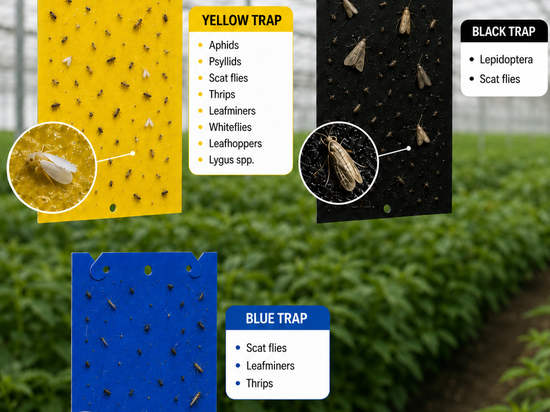
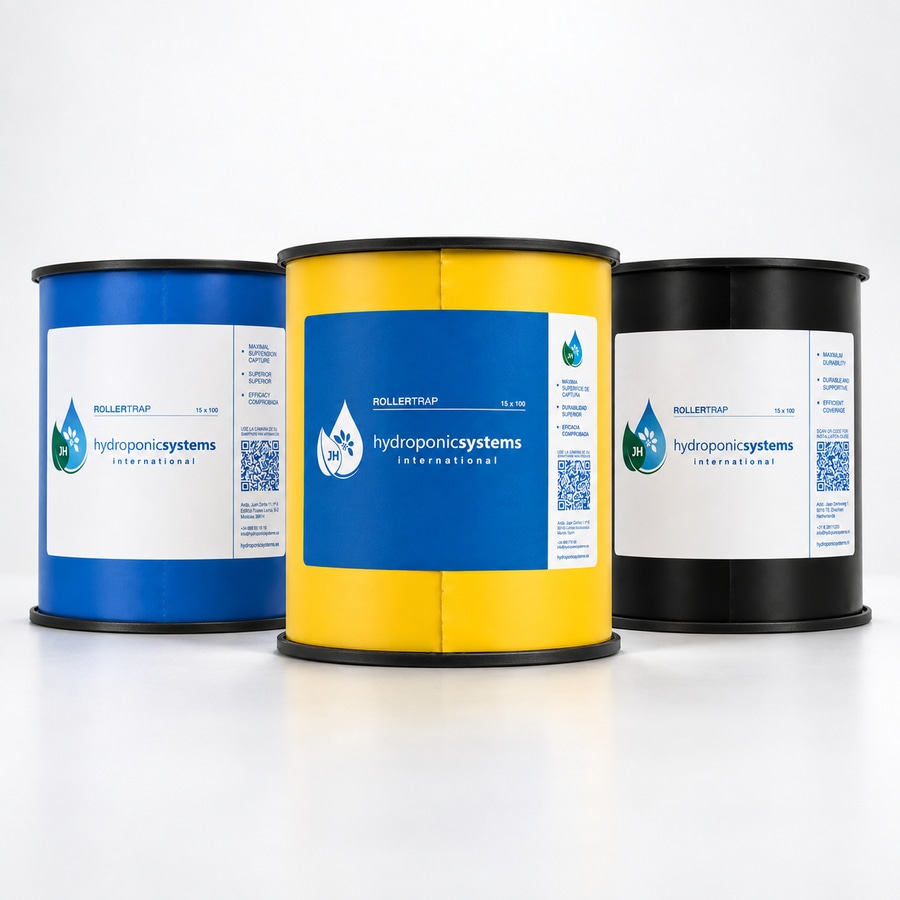
Blue rolls are mainly used when thrips are the priority. Yellow rolls are commonly selected for whiteflies, winged aphids and other flying insects attracted to yellow surfaces.
Some professional growers use both colours in the same greenhouse to monitor several pest populations during the same crop cycle.
Trap durability is also a labour issue
The real cost of a sticky trap is not limited to the purchase price. Growers also need to consider the time required to install it, replace it and remove it at the end of the crop.
This becomes particularly important when thousands of individual traps are used across a commercial greenhouse.
Traditional chromatic traps may require twine, staples or additional manual operations. Double-hook traps can be suspended directly and removed by pulling them down, reducing the number of installation steps.
In internal installation trials carried out with Hydroponic Systems traps, the difference between traditional installation and the double-hook system represented approximately 18 labour hours per hectare. For 5,000 traps, the combined saving during installation and removal can reach approximately 47 hours.
At commercial scale, this time becomes a measurable production cost.
Sticky roll or individual trap?
The two formats solve different problems.
Sticky rolls are suitable when a large and continuous adhesive surface is required. They can be installed along crop rows for intensive monitoring or mass trapping.
Individual traps are more suitable when growers need precise monitoring points in different parts of the greenhouse. They can also help compare pest pressure between different areas.
In many professional greenhouse programmes, the two formats are complementary rather than competing solutions.
A European solution for professional growers and distributors
Hydroponic Systems manufactures chromatic sticky rolls and traps in Europe for professional agricultural use.
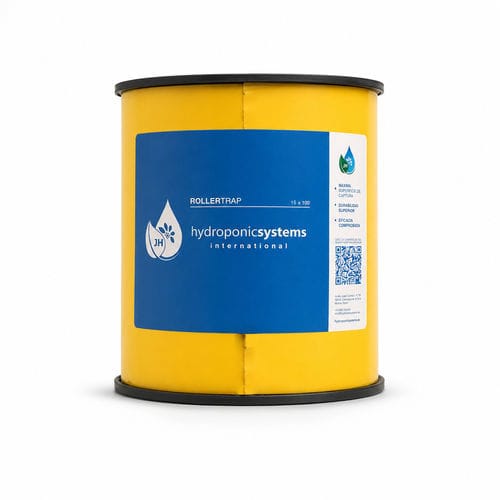
The Rollertraps are made from polypropylene and supplied in 100-metre rolls with different widths. Several colours are available so growers can adapt the trapping strategy to the target pest.
Chromatic traps are also available in different formats and can incorporate a double-hook system designed to reduce installation and removal time.
These products are intended for greenhouse growers, nurseries, horticultural farms, agricultural distributors and importers looking for a solution designed for repeated professional use.
What should growers check before buying?
Before purchasing a sticky roll or chromatic trap, growers should consider several factors. Adhesive quality and consistency are important, but so are material stability, ease of installation and resistance to greenhouse conditions.
The correct colour should also be selected according to the priority pest, while the format should match the size and layout of the growing area.
A cheaper product can become more expensive if it loses adhesive capacity too soon, deforms during use or requires additional labour.
To compare available colours, formats and distribution options, see the Hydroponic Systems Rollertraps and chromatic sticky traps available in the marketplace.