#Farm Machinery & Equipment
How to Prevent Irrigation Lines, Drippers and Stake Emitters from Becoming Clogged
Cleaning filters, flushing pipes and replacing blocked emitters may restore irrigation performance for a few days, but the problem often returns.
When clogging becomes recurrent, the cause is not always located in the dripper itself. In many agricultural installations, it begins several metres upstream, inside the pipes and irrigation hoses.
Irrigation water can carry organic matter, microorganisms, unicellular algae, silt, carbonates and fertiliser precipitates. Under favourable conditions, these materials contribute to the formation of biofilm, a sticky layer that adheres to the internal surfaces of the irrigation network.
Biofilm does more than reduce the available section inside a pipe. Its adhesive structure traps suspended particles, sediments and mineral deposits, fixing them to pipe walls and gradually transporting the problem towards the narrowest points of the system. Filters become dirty more frequently, dripper labyrinths lose flow, microtubes become obstructed and stake emitters stop delivering the required amount of water.
Replacing the affected component removes the visible obstruction, but it does not necessarily eliminate the source. If biofilm remains active inside the network, new deposits can form and the same maintenance cycle begins again.
The operational cost of recurring irrigation blockages
A single clogged dripper may appear to be a minor incident. The situation changes when the same problem affects hundreds or thousands of emitters across a professional farm.
Recurring blockages increase the time spent inspecting irrigation lines, cleaning filters, flushing sectors and replacing components. They can also reduce irrigation uniformity, create differences in substrate or soil moisture and interfere with the precise distribution of fertilisers.
In high-value crops, a small hydraulic deviation repeated throughout the irrigation cycle can affect root-zone conditions, nutrient availability, plant development and crop uniformity. The problem is therefore not limited to maintenance. It can become a production and profitability issue.
Corrective cleaning remains necessary when the network already contains significant deposits, but occasional interventions do not always prevent biofilm from developing again. As long as the water continues to provide microorganisms, organic matter and suitable growth conditions, the internal contamination process can restart.
Continuous water disinfection with in situ PHA generation
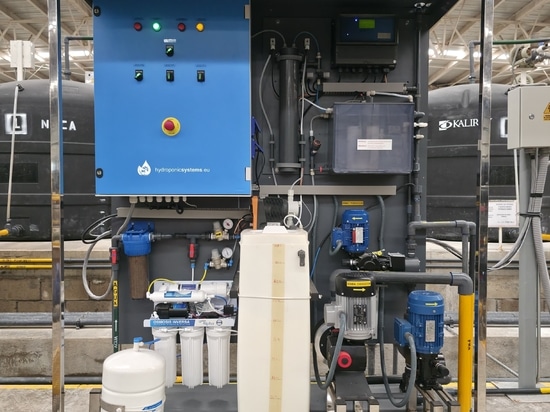
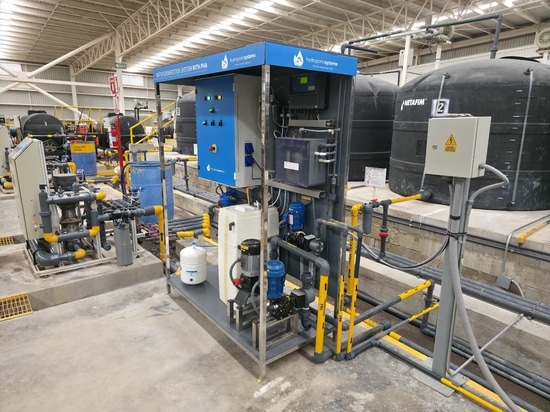
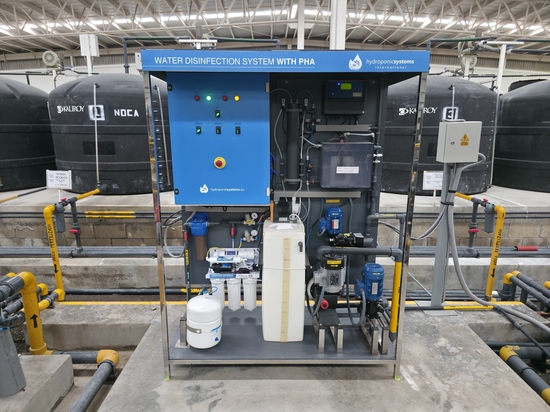
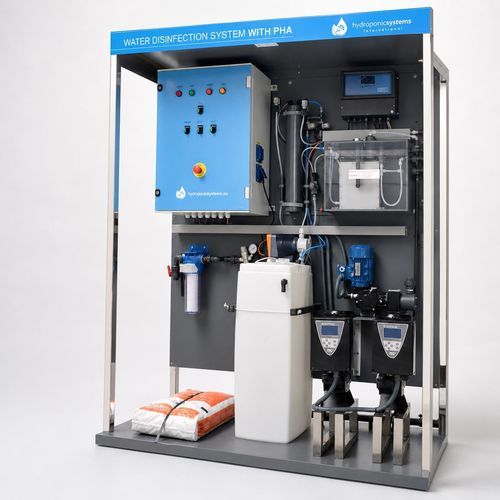
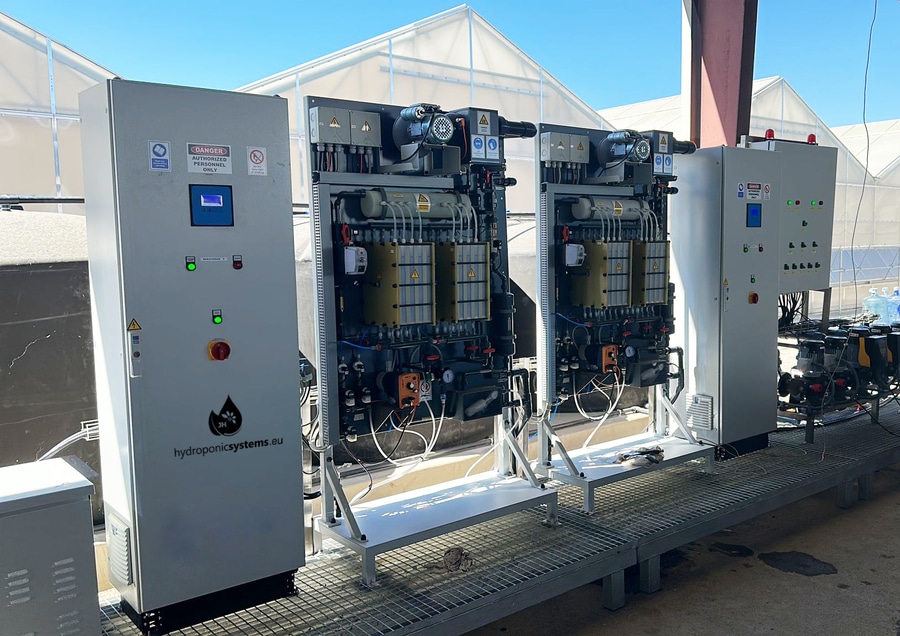
Hydroponic Systems supplies automated equipment that generates PHA directly at the agricultural facility and introduces it into the irrigation network under controlled conditions.
The system can operate continuously, 24 hours a day and 7 days a week, treating the water from the irrigation head unit instead of waiting for the next blockage to appear.
PHA helps reduce microbiological pressure, oxidise organic matter and destabilise the biofilm attached to pipes and irrigation components. Continuous treatment helps maintain cleaner filters, lines, drippers and stake emitters while reducing the conditions that allow biological deposits to consolidate again.
Because the PHA is generated on site, its production and dosing can be adapted to the actual irrigation programme. The system can be integrated into an existing technical room or irrigation head unit and automated according to the operational requirements of the farm.
Each system must be dimensioned for the installation
The correct machine cannot be selected only according to the number of hectares. The required capacity depends on the maximum irrigation flow, the number of head units, the sectors operating simultaneously, the water source, the filtration system, the duration of the irrigation cycles and the level of contamination already present.
It is also essential to determine whether the blockages are biological, physical, chemical or a combination of these factors. Silt, mineral precipitates and biofilm can occur simultaneously, so the most effective solution begins with a technical assessment of the water and hydraulic design.
Depending on the project, Hydroponic Systems can propose one centralised high-capacity unit or a modular configuration with several production and injection points.
Request a technical quotation
If filters become dirty again shortly after cleaning, irrigation lines require frequent flushing or drippers and stake emitters repeatedly lose flow, the problem may be developing throughout the network.
Hydroponic Systems analyses the crop, cultivated area, maximum irrigation flow, water source, filtration system and current clogging problem to define the appropriate PHA generation system.
Send us the basic information about your installation and request a customised technical and commercial quotation.
Contact Hydroponic Systems to assess your irrigation network and determine the most suitable in situ PHA generation system for your farm.