#Industry News
From Greenhouse to Garden Centre: Planning Moisture Care for Potted Flowers
Connecting production, dispatch and retail care—with horticultural hydrogel as a potential supporting tool.
A flowering plant may leave the greenhouse in excellent condition, yet its journey is far from over. Packing, transport, unloading and retail display introduce changes in how and when it receives water. For horticultural businesses, planning these transitions is part of delivering a plant that remains attractive and manageable for the next person caring for it.
The potting bench is a useful place to begin that planning. Decisions made during production—including the growing medium and any water-retention treatment—need to fit the plant’s whole route to market.
Think beyond the greenhouse watering routine
Inside a nursery, staff know the crop and follow an established irrigation schedule. Once plants are prepared for dispatch, that routine changes. A shipment may spend time awaiting collection, travel overnight or arrive before retail staff can place it on a watering bench.
These handovers deserve attention. Map the expected time between the last nursery watering and the first watering at the destination. Include loading and unloading time, rather than considering only the hours spent on the road.
Give each shipment a clear moisture plan
A dispatch plan should define who checks the plants, when that check takes place and what happens if collection is delayed. Plants should be assessed before packing so that unsuitable moisture conditions can be addressed while they are still accessible.
The objective is appropriate moisture for the crop and journey. Extra watering should not be used as a substitute for understanding drainage, packaging and transport conditions. Equally, a shipment should not be assumed ready simply because its leaves look fresh at the time of loading.
Where horticultural hydrogel may fit
For suitable container-growing systems, horticultural hydrogel can be evaluated as an additional water-storage component in the substrate. Its possible role in a distribution programme is to support moisture management during intervals when routine watering is interrupted.
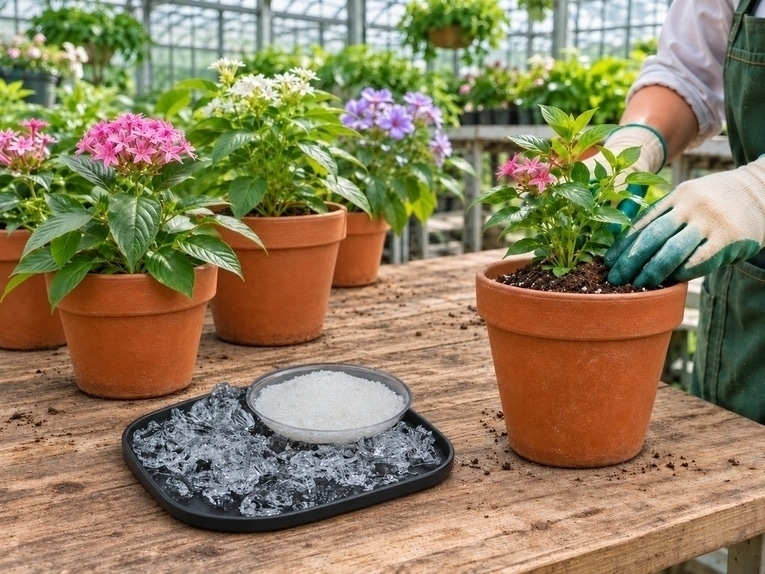
That role needs to be verified for the particular crop, substrate and journey. A tray of hydrated gel demonstrates the material’s appearance; it does not prove that treated plants can travel for a fixed number of days without watering. Any transport-related benefit should be based on observations from the intended supply chain.
Evaluate the journey, not only the growing stage
A nursery trial can extend beyond greenhouse production. Compare treated and untreated plants through the same packing process, transport period and receiving conditions. Record substrate moisture and plant condition at dispatch, arrival and after an agreed period of retail care.
Include the normal commercial packaging and a realistic delivery schedule. If delays are a recurring concern, assess a clearly defined delay scenario rather than making an open-ended claim about protection during transport.
Useful observations include the need for corrective watering, additional handling and the proportion of plants meeting the buyer’s presentation requirements. These measures connect the evaluation to everyday business decisions.
Make receiving instructions easy to follow
A water-retention treatment should not create uncertainty for the customer. Retail staff still need clear instructions on unpacking, inspection and ongoing watering.
Describe the care the plant requires rather than suggesting that a treated pot looks after itself. If hydrogel is incorporated into the substrate, explain that watering should continue according to the plant’s needs and actual substrate condition. This helps maintain consistent care after the nursery loses direct control of the crop.
Connect product decisions with customer experience
For a grower, the value of an application extends beyond what happens on the production bench. Consider whether it fits dispatch operations, supports straightforward care instructions and contributes to a commercially acceptable plant at the destination.
SOCO offers agricultural water-retention materials for nursery and horticultural applications. Growers can share their crop, container size, substrate, delivery duration and receiving arrangements with the SOCO team to discuss an application evaluation.
A stronger moisture-care plan connects the people who grow the plant with those who transport, display and care for it. That continuity is what turns a greenhouse product into a well-prepared retail plant.