#Crops
Degree days of apple pests
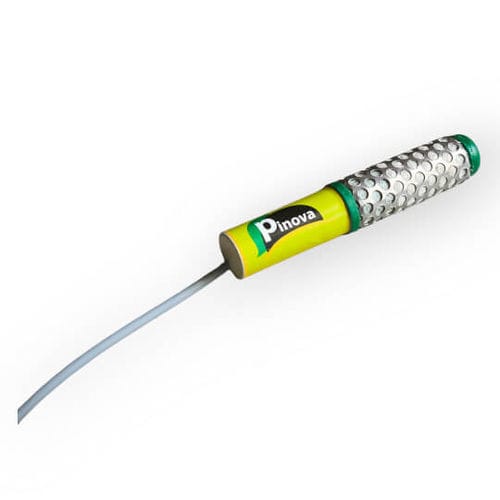
Pinova
Degree days represent the accumulation of heat energy over time. Heat strongly influences both plant and animal life, but since heat itself cannot be measured directly, temperature is used instead. This led to the development of the degree day model, which links accumulated air temperature to the growth and development of organisms.
To track plant development phases (phenophases), daily temperatures are converted into degree days. A degree day is defined as the accumulated heat above a specific threshold within a set period (day, month, season, or between two developmental stages). It is calculated by subtracting the threshold from the daily average temperature.
For example, if the threshold is 10 °C and the daily averages over five days were 12, 14, 9, 11, and 15 °C, the corresponding degree days would be 2, 4, 0, 1, and 5, giving a total of 12 degree days. The choice of threshold depends on the biological needs of the species—for instance, grapevine growth is often calculated with a base temperature of 10 °C.
Applications of degree days in agriculture include:
Comparing agricultural regions and growing seasons
Selecting crop varieties and planning plantations
Tracking the development of plant diseases and pests
Predicting plant growth stages
Scheduling agricultural practices
Temperature directly affects the development of many organisms. Pests require a certain amount of heat to progress through their life cycle. Each species has a constant heat requirement, expressed in degree days, which starts accumulating once temperatures exceed its base threshold. Development speeds up as temperatures rise, and slows when they drop. Because weather varies yearly, degree days help predict pest development stages and optimize the timing of control measures, reducing damage and treatment costs.
Key Apple Pests and Their Degree Day Models
Codling Moth (Cydia pomonella)
Overwinters as a caterpillar in cocoons under bark or in branch cracks. Pupation starts in April.
Base temperature: 10 °C
Degree day calculations begin January 1, summing daily averages above 10 °C.
Adult flight starts in late April, peaks in May, and continues through June.
Heat requirements:
Caterpillar → butterfly: 100 °C
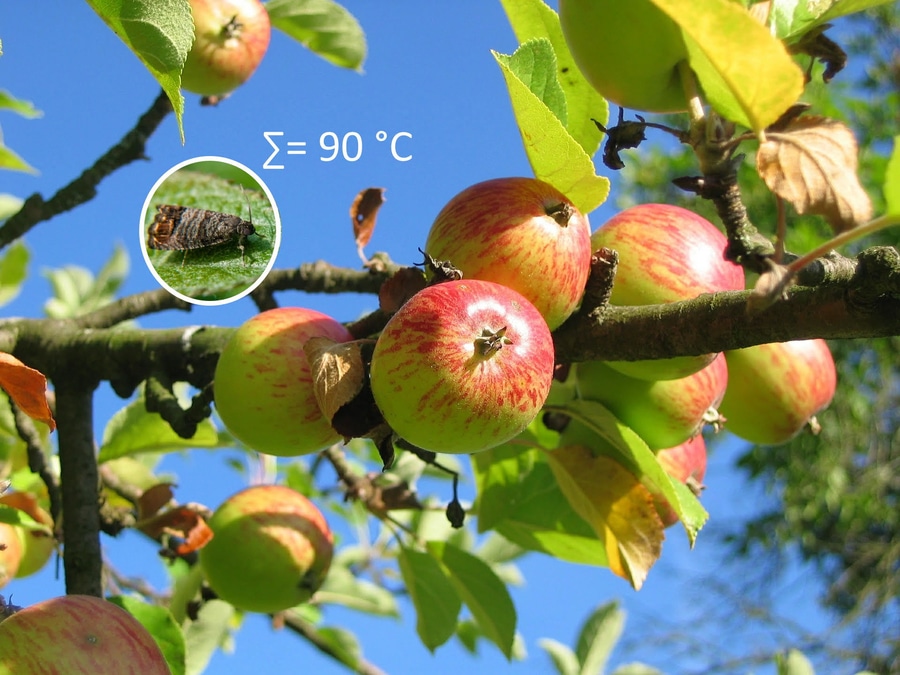
Egg → caterpillar: 90 °C
Full generation: 610 °C
Pest control:
Monitoring starts when 3–5 moths are caught in pheromone traps.
Apply insect growth regulators at 70 °C and contact insecticides at 90 °C.
In Croatia, the codling moth completes three generations per year.
European Red Mite (Panonychus ulmi)
Overwinters as eggs laid as early as August.
Base temperature: 10.6 °C
Degree day requirements:
Egg development: 69 °C
Larvae: 25 °C
Egg → adult: 140 °C
Egg → egg: 161.8 °C
Produces 6–7 generations annually.
Management:
In summer, treatment is recommended if more than 8 mites per leaf are found.
Winter sprays with mineral oils are effective at the start of vegetation.
Selective acaricides should be applied when about 30% of larvae hatch from overwintering eggs.