#Research & Development
Desert Planting Made Practical: How Water-Retention Hydrogels Lift Survival and Speed Up Restoration
A Sustainable Solution for Afforestation in Arid and Semi-Arid Regions
Planting in deserts is a race against water loss. Sandy, nutrient-poor soils drain fast, evaporation is relentless, and young roots struggle to find consistent moisture. That’s why desert revegetation projects often face low survival rates and repeated replanting cycles. A targeted water-retention strategy in the root zone changes the equation.
What the hydrogel does in deserts
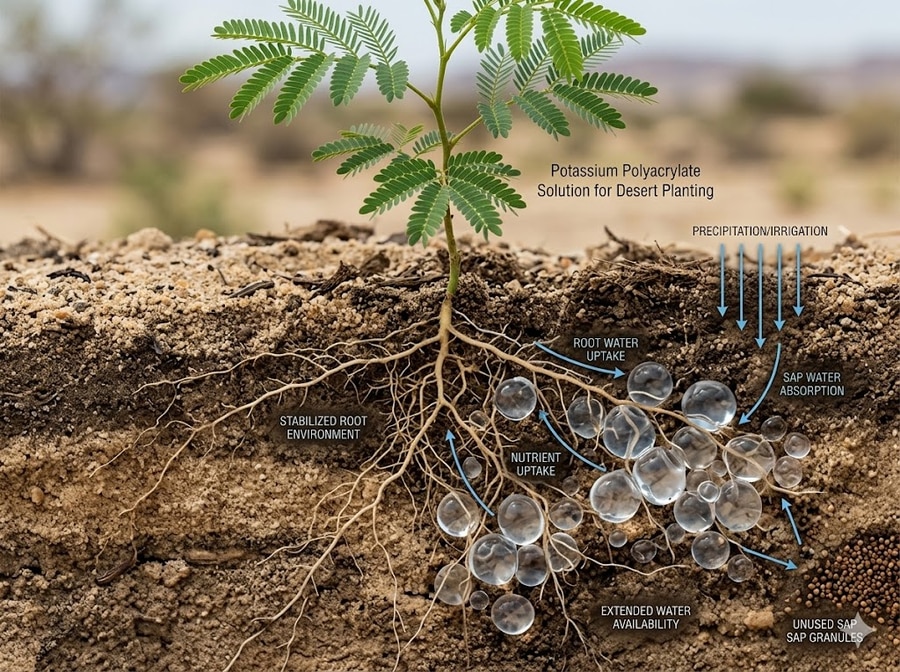
Stores water where it matters: Absorbs irrigation/rain and holds it at the root zone, then releases it gradually as the soil dries.
Buffers stress between waterings: Smooths out dry-down cycles, reducing transplant shock and early mortality.
Improves nutrient availability: Retains and slowly releases nutrients to roots in nutrient-poor sands.
Cuts labor and water use: Fewer re-watering passes and higher one-time planting success.
Documented outcomes
Survival uplift: Seedling survival in arid sites can increase by nearly 30%, turning multi-pass plantings into one-pass success.
Sand control impact: Establishing vegetation creates living barriers that can reduce sand movement by up to 40%, stabilizing surfaces and supporting ecosystem recovery.
Long-lasting effect: A single application supports establishment and early growth phases, helping stands become self-sustaining sooner.
How to use it
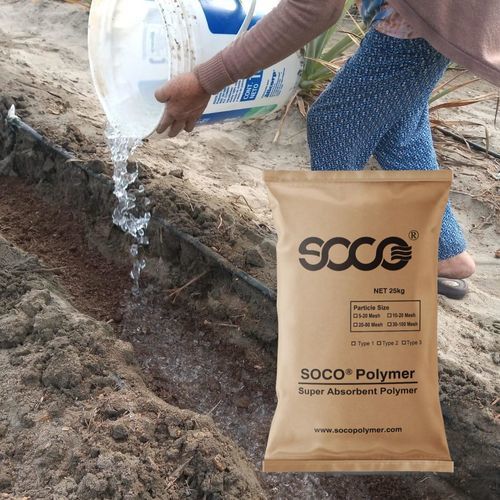
Placement: Incorporate the hydrogel directly in the planting hole or root zone. For seedlings, a small dose around roots creates a moisture “halo.”
Dosing example (case reference): About 5 g/plant (wet application) was used for straw seedlings in the Maowusu Desert, Shanxi, China, with TRPSORB-120.
Timing: Apply at transplant to protect through the most vulnerable weeks.
Pairing: Combine with site-appropriate nutrition and mulching for best results.
Where it fits best
Desert afforestation and greening projects
Highway and infrastructure windbreaks
Restoration of degraded dunes and sandy plains
Urban fringe sand-control plantings
Getting support
For guidance on species, soil type, and irrigation constraints, share your plant list, target spacing, and water schedule. I can recommend root-zone placement and starting dosages tailored to your site conditions.