#Crops
Healthy Soil Structure: How Super Absorbent Polymers Lock In Moisture, Pores, and Yield
Unlocking Sustainable Crop Growth in Saline Soils with Advanced Water-Retaining Polymers
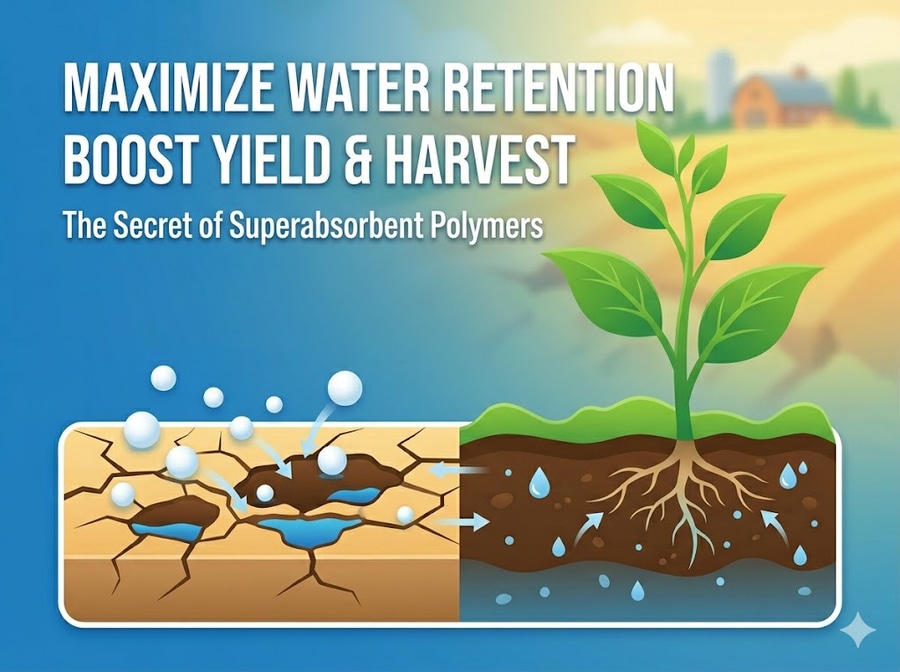
As a super absorbent polymer specialist, I’ve seen a common pattern across fields: aggregates slake under intense rain or sprinklers, fines disperse, and surface crusts form. The result is uneven wetting, shallow roots, runoff, and fertilizer loss. SOCO Soil Hydrogel addresses these structural failures where they start—within the pore network. By absorbing and releasing water in sync with wet–dry cycles, SAPs regulate pore continuity, buffer surface stress, and hold moisture and nutrients in the root zone, so more irrigation and rainfall become usable water instead of runoff.
The Soil Structure Challenge
Erosion and slaking: Impact from raindrops or sprinklers compresses trapped air inside aggregates. When that air escapes suddenly, aggregates collapse into fines that wash away with runoff—taking nutrients with them.
Surface sealing and crusting: Dispersed fines settle and dry into a hard crust that blocks air and water, slowing emergence and pushing roots shallow.
Uneven infiltration: Wet–dry swings create ponding and dry spots, forcing extra fieldwork after storms and causing yield swings with the weather.
How SOCO Soil Hydrogel Works
Placing SOCO Soil Hydrogel (SAP) within the root zone—banded or incorporated—creates a micro-reservoir system that:
· Absorbs part of each irrigation/rainfall and releases it back as the soil dries
· Moderates wet–dry stress on aggregates (“breathing” effect) to reduce sealing and runoff
· Maintains near-root moisture and nutrient availability for steadier uptake
In clayey or compacted soils, the swell–shrink cycle of SAPs exerts gentle mechanical force that:
· Breaks up compaction and increases porosity
· Promotes aggregate formation and better aeration
· Supports deeper rooting and more uniform stands
Why It Reduces Runoff and Crusting
Even infiltration: Hydrogels smooth delivery of water into the profile, reducing both ponding and hydrophobic dry patches.
Fines retention: As SAPs hydrate, they help hold fine particles within a gel-supported matrix, limiting dispersion that leads to crusts.
Pore regulation: Repeated absorb–release cycles stabilize pore continuity, so subsequent irrigations infiltrate predictably.
On-Farm Benefits You Can Measure
· More usable moisture: A greater share of rainfall/irrigation stays in the profile
· Deeper, more resilient roots: Better access to water and nutrients
· Reduced fertilizer loss: Nutrients remain in the root zone longer
· Less rework after storms: Fewer crusts, fewer stand gaps
· More consistent yields: Lower weather-driven variability
Where to Use It
· Field crops and vegetables with slaking-prone, silt-rich, or low-OM soils
· Horticulture and greening projects where uniform emergence matters
· Lawn/landscape and transplanting zones that suffer crusting and dry spots
· Desert and arid plantings requiring tighter moisture control
Placement and Use Guidelines
Placement: Band or incorporate hydrogels in the active root zone. For transplants, blend into backfill; for row crops, place near the seed line or side-band into the rhizosphere.
Rate selection: Choose rates according to soil texture, expected irrigation frequency, and crop rooting depth. Finer textures and longer intervals between water events may benefit from higher rates.
Water management: After application, you can often extend irrigation intervals or reduce run time—verify with soil moisture checks.
Compatibility: SOCO Soil Hydrogel complements wetting agents and organic amendments; avoid mixing directly with high-salinity solutions without rate adjustments.
Why SAPs Improve Structure Over Time
The wet–dry cycling of SAPs does more than store water—it imparts micro-mechanical action in the surrounding soil. This cyclical swell–shrink:
· Compresses and then relaxes adjacent soil
· Encourages micro-aggregation and pore formation
· Creates a friendlier habitat for beneficial microbes (e.g., N-fixers), further supporting aggregate stability
Choosing the Right SOCO® Solution
TRPSORB™, FERTISORB™, HORTISORB™, GREENSORB™, CROPSORB™: Water and fertilizer boosters suited to varied crops and systems
SATSORB™: Anti-salt grades for saline or sodic conditions
Potassium vs. Sodium Polyacrylate: Potassium polyacrylate forms are often preferred in agriculture to avoid sodium loading; sodium grades can be used where appropriate and with management practices that prevent dispersive effects
Field Tips from an SAP Specialist
Start where losses are highest: Slopes, headlands, and compacted tracks often show the most slaking and crusting.
Pair with residue: Ground cover reduces raindrop impact; SAPs then regulate pore moisture beneath.
Monitor EC: In saline zones, select salt-tolerant grades (e.g., SATSORB™) and adjust rates upward.
Calibrate spreaders: Even distribution matters—banding or incorporation beats surface broadcasting on bare soil.
Validate with digs: Pit checks 24–72 hours after irrigation confirm placement and moisture distribution.