#Industry News
Fencing - which is best for me? Does a bun scare away a wolf?
Are you thinking about a fence but you are not sure which should you choose?
Every decision we make is important. It doesn't matter whether it's buying our morning bread or, perhaps even more importantly, buying a fence that will protect what we love. One thing I know for sure – you can't beat a wolf with a piece of bread. For many years, it was believed that fencing mesh simply needed to be in place and that any mesh would pass every test equally. Nothing could be further from the truth.
We distinguish several basic types of mesh, from those used for breeding, forestry, or whatever you prefer to call them.
The basic and weakest mesh is the one with a "hinge joint." This is a mesh in which pieces of wire are joined together during the production process by twisting them into this knot. While this is a quick and efficient production process, this makes the mesh not very strong. It's like making a bicycle frame from 40 pieces. Each joint potentially weakens the entire structure. That's why it's made as a single piece. This ensures adequate stiffness and durability.
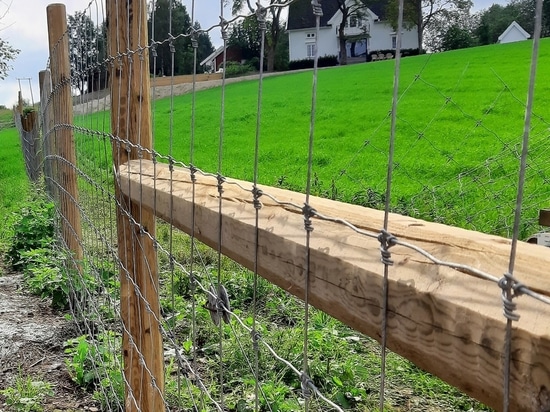
And this is where the fundamental difference between a "hinge joint" net and a "Cravat-Lock" or fixed knot net arises. Cravat-Lock is precisely this monolith, this frame, precisely cast to ensure the appropriate stiffness and strength in the right place. These nets have both vertical and horizontal wires in one piece. Only the third wire creates this unique knot and holds the whole thing together. So, for example, when unrolling 100m of this net, each horizontal wire represents 100m of unbroken wire. The same applies to the vertical wires. For a 200cm-high net, each vertical wire is a 200cm section of wire. This construction is many times stronger than a broken or tangled one. That's why fixed knot netting is considered the strongest net on the market. The material is also important.
Unfortunately, for several years now, we have been witnessing a flood of wire from China in Europe, including Poland. The key factor is its significantly lower price. However, other factors also come with a lower price. A piece of wire sent for testing revealed a zinc coating almost 20% thinner than what was listed on paper. The wire diameters, which are also responsible for its strength, were 7-10% smaller than those ordered. This is clearly below the tolerances for such materials. Therefore, the material's origin is crucial.
At Farmmesh, we manufacture our Cravat-Lock mesh according to the highest quality standards. We purchase wire exclusively from European manufacturers. All batches are tested for key parameters and passed on with each delivery. We are proud that the product you receive is made in Poland, but it is also 100% European in origin. We believe in both micro- and macro-regionalism. Not only Poland, but also Europe is our home, so we proudly support the old continent and will continue to do so.
Let's remember the origin of every product and support companies as close to us as possible.
Just like with the aforementioned bread: would you buy a roll from China? Or maybe better than a local baker who bakes with Polish or Ukrainian flour?